

Moving up from a weekend car wash to professional detailing is a lot like graduating from a home kitchen to a chef's station. You can make a good meal in both, but the tools, ingredients, and techniques a pro uses are all about precision, efficiency, and getting that perfect result every single time. The same holds true for professional car detailing products. They’re a completely different beast than what you grab off the shelf at the local auto parts store.
The real difference is in the chemistry and concentration. Consumer products are usually sold ready-to-use because convenience is key. Professional products, on the other hand, are often super-concentrated. You dilute them to specific ratios for different jobs, which not only makes them far more economical but also gives you complete control over the cleaning power you need for any given situation.
Why Professional Products Make a Difference
Going pro with your supplies isn't about chasing fancy labels. It's about using better chemistry and purpose-built tools to get a finish that's simply out of reach with basic soaps and sponges. This is how car care stops being a chore and starts becoming a craft.
What used to be a niche hobby has exploded into a massive industry. Thanks to a flood of great products and endless online tutorials, anyone with enough dedication can now achieve professional-level results right in their own driveway. If you're curious, you can learn more about the evolution of the detailing industry and its surprising growth.
The core philosophy of professional detailing is to work smarter, not harder. Each product is engineered to do one specific job exceptionally well, whether it’s safely lifting stubborn grime or laying down a durable, glass-like shield over the paint.
Understanding the Product Categories
A pro's cabinet is organized by function, with every bottle playing a vital role in the process. Having a well-stocked toolkit means you’re ready for any challenge, from chemically dissolving brake dust to restoring faded black trim.
Let's break down the essential product types. Think of these as the building blocks for any serious detailing kit.
Here's a quick look at how these core categories fit into the big picture:
Core Professional Detailing Product Categories at a Glance
| Product Category | Primary Function | Detailing Stage |
|---|---|---|
| Soaps & Shampoos | Safely remove loose dirt, grime, and road film without stripping protection. | Wash & Decontamination |
| Degreasers & Cleaners | Break down tough grease, oil, tar, and stubborn contaminants. | Wash & Decontamination |
| Clay Bars & Mitts | Mechanically lift embedded contaminants from the paint's surface. | Decontamination |
| Compounds & Polishes | Abrasively remove paint defects like scratches, swirls, and oxidation. | Paint Correction |
| Waxes, Sealants, & Coatings | Provide a protective layer that enhances gloss and repels water/dirt. | Protection |
| Tools & Accessories | Safely apply and remove products without causing scratches. | All Stages |
Each of these categories contains a whole world of specialized products, but understanding their basic roles is the first step to building a truly effective detailing arsenal.
Decontamination: The Foundation of a Flawless Finish
A professional detail starts long before any polish or wax ever touches the paint. The real work—the part that truly sets a pro job apart from a quick wash—is decontamination. It’s a two-stage process designed to strip away every last bit of grime, both the stuff you can see and the nasty stuff you can't.
Think of it like this: your car's paint is like your skin. A simple wash gets the surface dirt off, but a deep cleanse is what removes the embedded impurities for a genuinely healthy glow. Honestly, this foundational stage is 90% of the job.
First up is chemical decontamination. This is where we let specialized products do the heavy lifting, chemically dissolving specific types of gunk. A good pre-wash snow foam, blasted from a foam cannon, is your first line of attack. It blankets the vehicle and starts breaking down heavy dirt and road film, letting you rinse most of it away before a wash mitt even gets near the paint.
After the foam, a pH-neutral shampoo gets the remaining surface dirt off without stripping any existing protection. But the real deep clean comes from more targeted chemicals. Iron removers are a perfect example; they react with tiny metal particles from brake dust and industrial fallout, making them "bleed" a wild purple color as they dissolve right off your paint. For the really stubborn stuff like tar spots, grease in the engine bay, or grime in the wheel wells, a powerful degreaser is your best friend.
Physical Decontamination: Getting Rid of What's Stuck On
Once the chemical assault is over, it’s time for physical decontamination. This step is all about removing bonded contaminants—those gritty little specks you can feel when you run your hand over the paint. We're talking about things like tree sap, paint overspray, and rail dust that have stubbornly latched onto the clear coat.
If you leave them, the surface will feel rough, and your polishes and waxes won't be able to bond correctly.
The go-to tool for this has always been the detailing clay bar, though clay mitts are now a popular alternative.
- Clay Bar: This is a synthetic putty that you glide across a lubricated surface. It gently shears off and grabs onto any contaminants sticking up from the paint, leaving it perfectly smooth.
- Clay Mitt/Towel: Think of this as a microfiber towel with a special rubbery polymer face. It does the same job as a clay bar but is often faster to work with and, best of all, you can just rinse it if you drop it.
This diagram shows the jump from basic consumer products to the more refined tools and concentrates a professional uses.
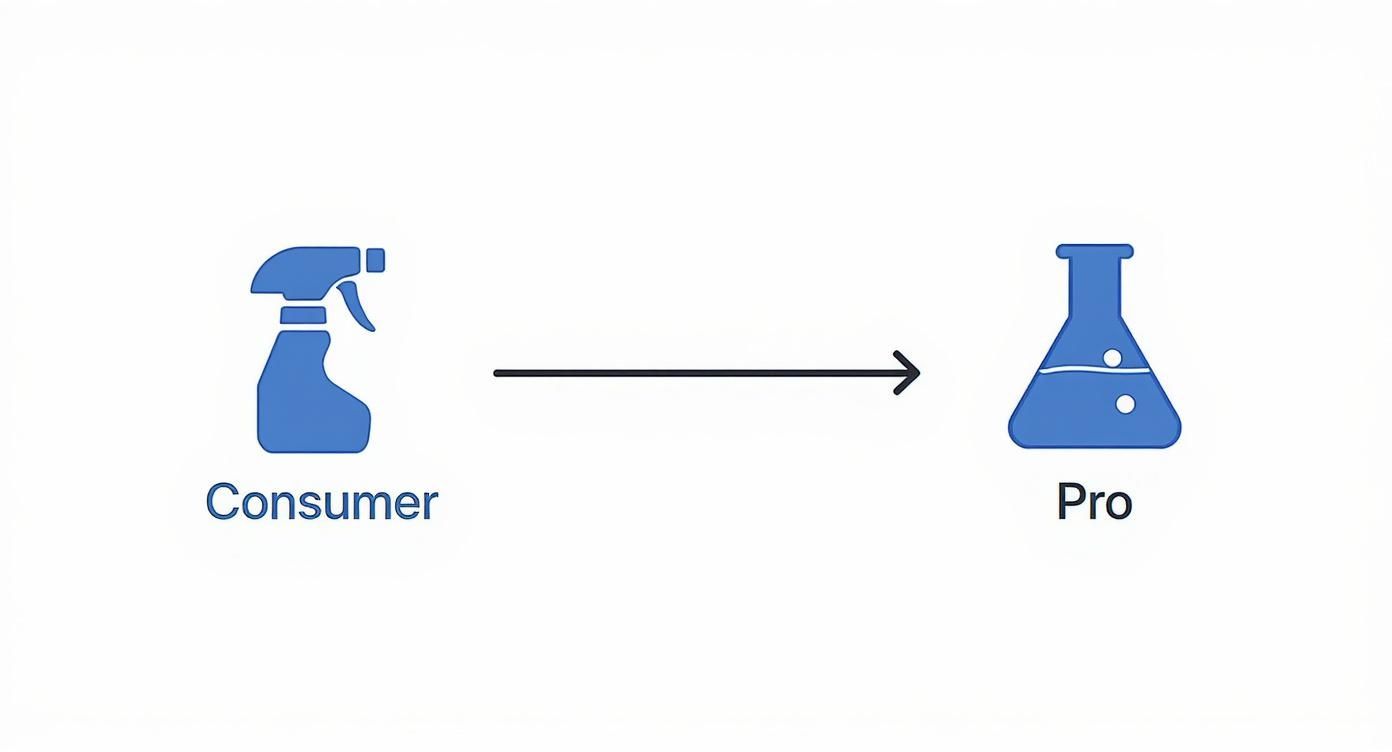
You can see the shift from a simple, ready-to-use spray bottle to a lab-style beaker. That visual says it all: pros focus on concentrated formulas and precise chemical work.
The whole point of decontamination is to create a perfectly clean and smooth canvas. If you skip this, you’re essentially just grinding dirt and grit into the paint during the polishing stage, which creates more damage than you fix.
To use a clay bar properly, the surface must be kept wet with a dedicated clay lubricant or a quality quick detailer spray. This lets the bar glide without scratching or marring the paint. You'll want to work in small, two-foot by two-foot sections and fold the clay often to expose a fresh, clean surface.
For a complete rundown, take a look at our guide on how to clay bar a car with this easy step-by-step guide. Once you’re done, the paint will feel as smooth as glass and be perfectly prepped for the next steps: paint correction and protection.
Paint Correction: Removing Swirls and Restoring That Showroom Gloss
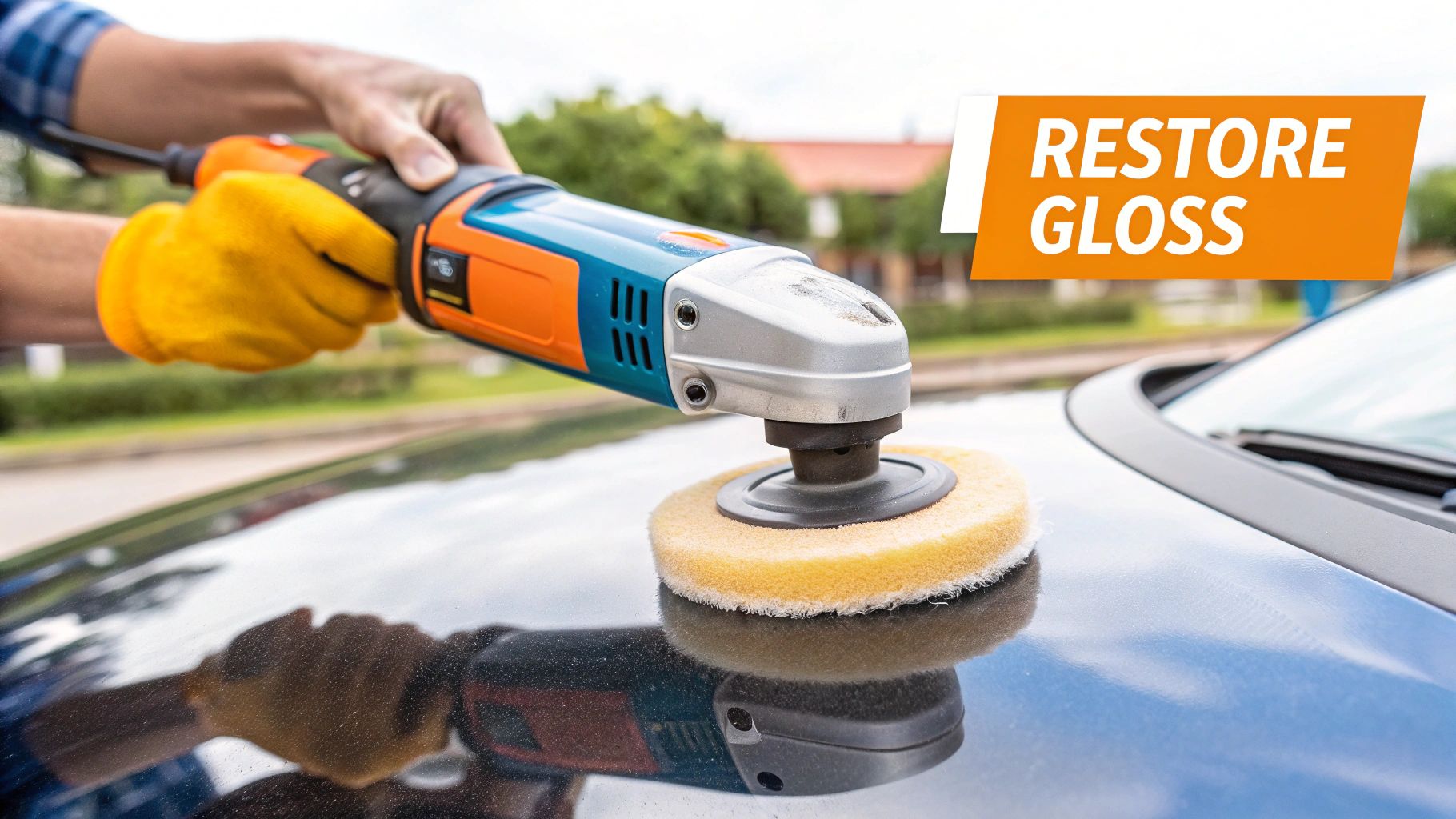
Alright, your car's surface is squeaky clean and decontaminated. You’ve prepared the perfect canvas. Now we get to the part that truly separates a car wash from a professional detail: paint correction. This is where we physically remove the imperfections in your clear coat to bring back that deep, flawless, mirror-like finish.
The professional car detailing products for this stage—compounds, polishes, and glazes—are all about leveling the paint. Think of it like refinishing a piece of wood. You start with coarse-grit sandpaper to knock down the big scratches, but that leaves behind its own finer scratches. So, you follow up with progressively finer grits until the surface is perfectly smooth and ready for a finish.
Paint correction products operate on that exact same principle, using microscopic abrasives to deliver incredible results.
Understanding Your Abrasive Arsenal
The secret to great paint correction is picking the right tool for the job. Going in with a product that’s too aggressive can chew through your clear coat, but using one that's too gentle will just waste your time and not remove the defects.
- Compounds: These are your heavy hitters, the coarse-grit sandpaper in our analogy. They’re packed with larger, sharper abrasives designed to slice through the clear coat and level out deeper defects like heavy swirl marks, noticeable scratches, and oxidation.
- Polishes: Polishes are the fine-grit sandpaper. They use much smaller abrasives to refine the surface left behind by the compound. Their job is to remove any leftover hazing or micro-marring, which is what restores that jaw-dropping gloss and clarity.
- Glazes: Now, glazes are a different animal. They contain zero abrasives. Instead, they’re loaded with oils and fillers that just temporarily hide minor swirls and imperfections. Think of it as a cosmetic quick fix—fantastic for adding a pop of depth right before a car show, but the effect is temporary and will wash away.
Paint correction isn't about adding shine; it's about revealing it. By meticulously removing a microscopic layer of the damaged clear coat, you're exposing a fresh, flat surface that reflects light perfectly. That’s where true gloss comes from.
The Essential Tools for a Professional Job
Let’s be clear: getting pro-level results is next to impossible by hand. Machine polishers are absolutely non-negotiable for doing this consistently and efficiently. It’s the combination of the machine, the polishing pad, and the liquid working together that creates the magic.
You’ll mainly run into two types of machines:
- Dual-Action (DA) Polishers: These are the go-to for most detailers, and for good reason. They're safe, effective, and perfect for beginners and pros alike. The pad spins and oscillates in a random pattern, which spreads out the heat and dramatically lowers the risk of burning through the paint.
- Rotary Polishers: These are the power tools of the detailing world. The pad spins on a single, fixed axis, which generates a lot more heat and cutting power. A skilled pro with a rotary can fix severe defects incredibly fast, but in the wrong hands, it can cause serious damage in seconds.
Just as crucial is pairing the right pad with your product. Pads come in different materials (foam, microfiber, wool) and densities. You’d use a firm, aggressive cutting pad with a compound for heavy lifting, then switch to a soft foam finishing pad with a fine polish to really make that gloss pop. This careful dance between machine, pad, and product is how you restore any car's paint to a condition that’s even better than new.
Choosing Your Armor: Waxes, Sealants, and Coatings
After all that hard work—the deep cleaning, the claying, the polishing—you’ve finally got a perfect, gleaming surface. But what's next? To skip the final step of protection is like building a masterpiece and leaving it out in a hailstorm. This is where you lock in all that effort and shield your paint from the daily grind.
It's time to choose your vehicle’s armor. The world of professional car detailing products gives you three main options, and each one brings something different to the table in terms of its chemistry, its look, and how long it lasts. Think of it like picking a jacket: you've got the classic leather, a functional raincoat, and a high-tech GORE-TEX shell.
Traditional Carnauba Waxes: The Classic Warm Glow
Carnauba wax is the old-school hero, the leather jacket of paint protection. It’s a natural wax harvested from a Brazilian palm tree, and detailers have loved it for generations. Why? Because it delivers a deep, warm, wet-looking gloss that makes colors, especially dark ones, just pop. It’s a purely sacrificial layer that sits right on top of your paint.
Working with a quality carnauba paste is a truly satisfying process. But because it’s a natural product, it doesn't last forever—you’re looking at a lifespan of a few weeks to a couple of months. It does a decent job fending off sun and rain, but harsh soaps and environmental grime will break it down fairly quickly.
Synthetic Paint Sealants: Modern Durability and Shine
If carnauba is the classic jacket, a synthetic sealant is the modern raincoat built for performance. Sealants are completely man-made polymers, engineered to do one job and do it exceptionally well: last. Instead of just sitting on the paint, these polymers cross-link and actually bond to the surface on a chemical level.
This bond creates a far more durable barrier, often giving you six months or more of solid protection. The look is different, too. Sealants are known for creating a sharp, slick, almost glass-like shine. They stand up much better to heat, UV rays, and strong detergents than any traditional wax can.
The choice between wax and sealant often comes down to what you value more: aesthetics or longevity. Do you want that warm, organic glow of carnauba and don't mind reapplying it more often? Or do you prefer the sharp, synthetic brilliance of a sealant that offers months of set-it-and-forget-it protection?
Ceramic Coatings: The Ultimate Protective Shell
Ceramic coatings are the GORE-TEX of the detailing world—the most advanced and toughest option out there. These are liquid polymers, usually based on silica (SiO2) or silicon carbide (SiC), that form a chemical bond with your car’s clear coat. The result is a semi-permanent, glass-like shell that becomes a functional part of the surface itself.
This hardened layer provides a level of protection that waxes and sealants simply can't match.
- Extreme Durability: A professionally applied coating can last for years, not months.
- Chemical Resistance: It provides a stout defense against nasty stuff like bug guts, bird droppings, and harsh chemicals.
- Superior UV Protection: This ceramic layer is your best bet for preventing paint oxidation and fading from the sun.
- Intense Hydrophobics: Coatings are famous for their insane water-beading. This "self-cleaning" effect makes the car much easier to wash and helps it stay clean longer.
The soaring demand for this level of protection is a huge reason the detailing industry is growing so fast. The global car detailing services market hit a massive USD 41.40 billion and is expected to climb to USD 58.06 billion by 2030. This shows a real shift in how people think about car care—it's less about a quick wash and more about long-term preservation. You can read more about this market growth on Grand View Research. While waxes and sealants definitely still have their place, ceramic coatings have become the pinnacle of modern vehicle protection.
Essential Tools for Pro-Level Application
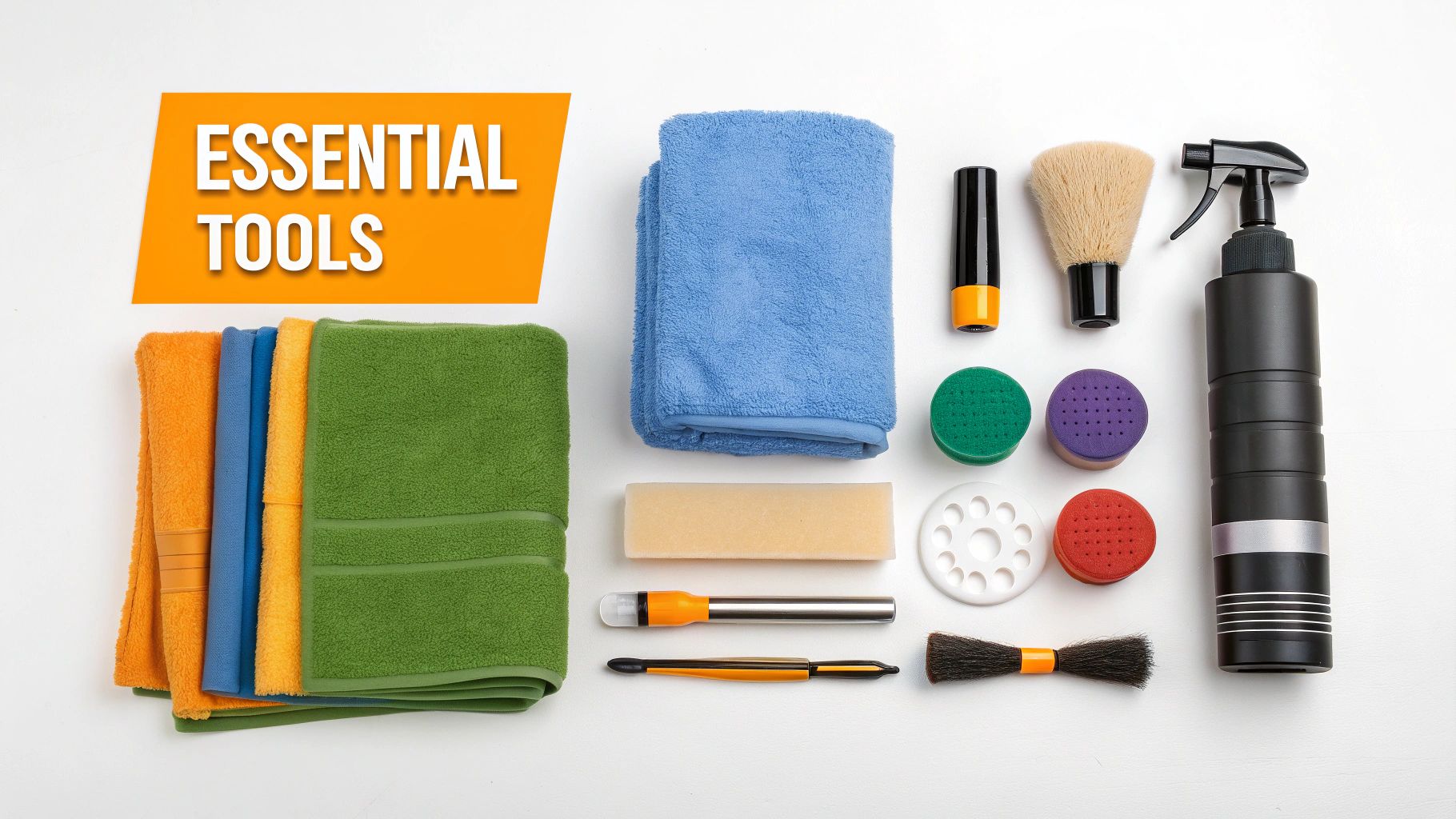
Even the absolute best professional car detailing products are useless if you apply them with the wrong tools. The real MVPs of any detail are the high-quality applicators and towels that connect the product to the paint. They're what guarantee a safe, efficient, and stunning result.
Think of it like this: a master painter would never use a cheap, shedding brush. In the same way, a detailer’s tools are their secret weapon against damaging a car’s finish. Grabbing an old t-shirt or a kitchen sponge is the fastest way to put swirl marks and scratches right back into the paint you just perfected.
Mastering Microfiber Technology
The most critical tool in any detailer’s bag is the microfiber towel. But here's the thing—not all microfiber is the same. The key difference you need to know is GSM, or grams per square meter. It’s a simple measurement of a towel's density and softness.
- Low GSM (200-350): These are the workhorses. With a shorter, tighter weave, they're perfect for wiping down interiors, cleaning dirty door jambs, or other general-purpose tasks.
- Medium GSM (350-500): This is your go-to for buffing off polishes, waxes, and sealants. They have a great balance of softness to protect the paint and just enough bite to remove product residue cleanly.
- High GSM (500+): These are the ultra-plush, super-absorbent towels you save for the most delicate jobs. Their main purpose? Drying. They can soak up a massive amount of water, cushioning the paint to prevent scratching as you dry the vehicle.
Beyond GSM, the actual weave makes a huge difference. A waffle-weave towel, for example, has special pockets that trap water, making it another fantastic option for drying. A pearl-weave is tighter and excels at leaving glass perfectly streak-free. For more ideas on building out your toolkit, check out our guide to the 12 best sources for professional car detailing tools.
Specialized Brushes and Game-Changing Equipment
While towels cover the big, flat surfaces, you need specialized brushes to get into all the nooks and crannies where dirt and grime love to hide. A set of soft, boar's hair detailing brushes is essential for safely cleaning around emblems, intricate grilles, and dashboard vents without leaving a mark. The stiffer brushes are reserved for the heavy-duty work, like scrubbing tire sidewalls or agitating tough grime on wheels.
The right tool isn’t just about getting a better result—it’s about safety. Pre-soaking a car with a foam cannon lifts and lubricates heavy grit before your wash mitt ever touches the paint. This simple step drastically reduces the risk of wash-induced scratches.
For anyone serious about achieving top-tier results, a few key pieces of equipment can completely change the game. A quality foam cannon, like the SwiftJet, can turn any standard garden hose into a powerful pre-wash system, blanketing the car in thick foam that loosens dirt for a safer wash.
When you move to the interior, a hot water extractor is the ultimate weapon for deep-cleaning carpets and upholstery. It works by injecting a hot cleaning solution deep into fabric fibers and then using powerful suction to pull out all the loosened dirt and moisture. This is how pros get stained seats and soiled floors looking factory-fresh again.
Your Professional Detailing Product Buying Guide
Walking into the world of professional car detailing products can feel a bit overwhelming. The sheer number of options, technical jargon, and marketing claims is enough to make anyone’s head spin. This guide is your no-nonsense checklist to help you invest wisely and build a detailing arsenal that actually works.
Think of it like building a custom toolbox. You don't just grab random tools; you pick specific ones that work together seamlessly. The same logic applies here. You need to understand how each product interacts with your car's surfaces and the other chemicals you’re using. The wrong combination can do more harm than good, and nobody wants that.
Key Selection Criteria
Before you click "add to cart," run every potential purchase through this mental checklist. Taking a moment to answer these questions will save you time, money, and a lot of headaches later. It’s what separates a well-rounded, effective kit from a shelf full of mismatched, unused bottles.
-
Surface Compatibility: Is this product truly safe for the surface I’m cleaning? For instance, a heavy-duty acidic wheel cleaner works wonders on tough, clear-coated alloy wheels. But use that same cleaner on polished aluminum, and you could permanently etch the finish. Always double-check the pH level and what the manufacturer recommends. A detailer restoring a classic car with delicate single-stage paint needs a far gentler polish than someone correcting the rock-hard clear coat on a new truck.
-
Dilution Ratios: Does this product come concentrated? A lot of professional-grade products do, and that’s where you find serious value. A single gallon of a high-quality all-purpose cleaner might dilute 10:1 for interior plastics and 4:1 for greasy engine bays. That means you're getting gallons of usable cleaner from just one bottle. The key is to always calculate your cost-per-ounce after you dilute it.
Investing in your detailing toolkit is all about finding products that are effective, safe, and economical. A brand's reputation isn't just marketing—it's built on a track record of consistent, professional-grade results trusted by people who detail for a living.
Reputation and Storage
The final two pieces of the puzzle are trust and proper care. What are the pros saying about a product, and how will you protect your investment once you've made it?
-
Brand Reputation: Look past the slick ads and fancy labels. What are the seasoned, everyday detailers actually using? Forums, honest reviews, and detailing communities are treasure troves of real-world feedback. A solid reputation is earned through consistent performance, making it one of the best indicators of a product you can rely on.
-
Proper Storage: These products are chemical investments, and they need to be treated as such. Extreme temperatures are the enemy. Letting your chemicals freeze in the garage over winter or bake in a hot trunk all summer can cause them to separate and become useless. The solution is simple: store everything in a cool, dry place out of direct sunlight to get the longest possible shelf life.
For a deeper dive into building out your full toolkit, check out our complete guide on car detailing supplies to get started.
Got Questions About Pro Detailing Products? We've Got Answers.
When you start looking at professional-grade detailing supplies, it's normal to have a few questions. Are these products overkill for a weekend hobby? Is a foam cannon really necessary? It's easy to get lost in all the options.
Let's clear things up. Think of this as a quick chat with a seasoned pro who's seen it all. We'll cut through the marketing fluff and get straight to the practical answers you need to invest wisely and get incredible results.
Can a Hobbyist Like Me Actually Use Professional Products?
Absolutely. Don't let the word "professional" intimidate you. It usually just means the product is more concentrated and delivers better performance, not that it’s harder to use. For any enthusiast who wants a deeper shine and longer-lasting protection, moving up to pro-grade supplies is the natural next step.
The only real difference is that you have to respect the product's strength. Just read the label, especially when it comes to dilution ratios. A great way to ease in is with things like pH-neutral shampoos, all-in-one polishes, and modern spray sealants. The payoff is a finish that the stuff from the local auto parts store simply can't touch.
What's the Real Difference Between Wax, Sealant, and Coating?
This is probably the most common question we hear, and it really comes down to chemistry and how long you want the protection to last. Think of them as different levels of armor for your paint.
- Wax (The Classic Leather Jacket): Waxes, especially natural carnauba, sit right on top of your paint. They provide that beautiful, warm, deep glow that car lovers obsess over, but the protection only lasts a few weeks to maybe a couple of months.
- Sealant (The Modern Raincoat): A sealant is a man-made polymer that actually bonds to your paint's surface. This chemical bond creates a slick, glassy, and highly reflective shine that can last for several months.
- Ceramic Coating (The Body Armor): This is the top tier. A ceramic coating is a liquid polymer (usually SiO2) that cures to form a hard, glass-like layer over your paint. We're talking years of protection, serious resistance to chemicals, and water-beading that's almost hypnotic.
All three add a layer of protection, but they're in completely different leagues when it comes to durability and performance. Your choice really depends on how much time you want to put in and the specific look you're going for.
Do I Really Need a Foam Cannon for a Good Wash?
Need? No. Should you have one if you're serious about protecting your paint? Yes. A foam cannon isn't just for making cool social media videos; it’s a crucial tool for preventing scratches.
Here's why it works: a foam cannon blankets your car in a thick layer of soap that clings to the surface. This foam gets to work immediately, loosening and lifting heavy dirt and grit. You can then rinse most of that grime away before your wash mitt ever touches the paint. This simple pre-wash step drastically cuts down the risk of dragging sharp particles across your clear coat, which is what causes those dreaded swirl marks.
How Often Should I Clay Bar My Car?
Forget the calendar. How often you need to clay your car has everything to do with where you park and how you drive, not a set schedule. For a daily driver, a good starting point is once or twice a year.
But the real way to know is the "baggie test."
The Baggie Test: After washing and drying your car, place your hand inside a thin plastic sandwich bag. Gently glide your fingertips over the paint. If it feels gritty or bumpy, it’s time to clay. If it’s perfectly smooth as glass, you can skip it for now.
A clay bar is designed to pull out bonded contaminants—think industrial fallout, rail dust, and tree sap—that washing alone can't remove. Using it too often can be slightly abrasive, so you only want to do it when it’s truly needed. The perfect time is right before you polish or apply a fresh layer of sealant or coating, as this gives your protection a perfectly clean surface to bond to.
Ready to make your wash process safer and more effective? The SwiftJet Car Wash Foam Gun turns any standard garden hose into a foam-generating machine, no pressure washer required. Get that thick, clinging foam and a scratch-free wash.
