

If you want the best possible car wash, start with the right hose. From my experience, nothing beats a 5/8-inch hybrid polymer or rubber hose that's between 50 and 75 feet long, capped off with some sturdy, crush-proof brass fittings. This isn't just a random recommendation; this setup strikes the perfect balance between water flow, flexibility, and sheer durability.
It delivers the volume you need to make foam cannons like the SwiftJet sing, it's pliable enough that you won't accidentally scratch your paint, and it’s built to last season after season.
Comparing Car Wash Hose Materials
Picking the right material for your hose is the first, and honestly, the most critical decision you'll make. It’s what separates a frustrating wash day from a smooth, satisfying one.
A cheap, stiff vinyl hose might save you a few bucks upfront, but you'll pay for it in aggravation. They kink constantly, fight you at every turn, and can even scuff your car’s finish. Investing in a better material from the get-go makes the whole process easier and more effective. We're mainly looking at rubber, hybrid polymer, and vinyl, and each has its place depending on your needs.
Material Strengths and Weaknesses
Rubber hoses have always been the heavy-duty champions of the detailing world. They’re incredibly flexible, even when it’s cold outside, and they can take a real beating without getting punctured or abraded. The trade-off? They're heavy and usually cost a bit more.
On the other end of the spectrum, vinyl hoses are super light and easy on the wallet. But that's where the good news ends. They are notorious for kinking, can crack in the cold, and tend to break down pretty quickly when left out in the sun.
This is where hybrid polymer hoses come in. They really are the best of both worlds, blending the flexibility and toughness of rubber with a much lighter weight. They stay pliable in hot and cold weather and do a great job resisting kinks, making them a fantastic all-around performer. Once you have a great hose, it becomes the foundation for everything else you do. Following a proper guide to a perfect ceramic car wash, for example, is much easier when your equipment isn't fighting you.
Key Takeaway: For most home detailers, a hybrid polymer hose hits the sweet spot of performance, weight, and value. Professionals who use their gear daily often stick with premium rubber for its unmatched, long-term durability.
Quick Comparison of Car Wash Hose Materials
To make things even clearer, here's a simple breakdown of how these materials stack up against each other for car washing.
| Hose Material | Key Feature | Kink Resistance | Best For |
|---|---|---|---|
| Rubber | Maximum durability and flexibility | Excellent | Professional detailers and heavy-duty use. |
| Hybrid Polymer | Balanced performance and light weight | Very Good | Most DIY enthusiasts and frequent washers. |
| Vinyl | Most affordable and lightweight | Fair | Occasional, light-duty use on a budget. |
Ultimately, the table shows there's a clear choice for every type of user. Your budget and how often you wash your car will point you directly to the right material.
Why Your Garden Hose Actually Matters
Picking the right hose for washing your car is about more than just finding one that reaches the driveway. The nitty-gritty specs on the packaging—diameter, length, material, and fittings—are what truly separate a great wash from a frustrating one. These details dictate everything from water flow and pressure to how much you'll fight with the hose itself.
A cheap, low-spec hose can turn a satisfying detail job into a complete chore. It'll kink every few feet, starve your foam cannon of the water it needs to make thick suds, and probably leak all over your shoes. Investing in a hose with the right specs isn't just about buying a tool; it's about getting a better, faster, and more enjoyable result.
Diameter: The Gold Standard for Flow
When it comes to hose diameter, size really does dictate performance. You'll typically see three options on the shelf: 1/2-inch, 5/8-inch, and 3/4-inch. While it might seem like bigger is always better, there's more to the story.
For pretty much any car washing scenario, the 5/8-inch diameter hose is the undisputed champion. It hits the sweet spot between two crucial factors:
- Serious Water Volume: It pushes a whole lot more water (measured in Gallons Per Minute, or GPM) than a 1/2-inch hose. This is absolutely critical for feeding a foam cannon like the SwiftJet. More water equals thicker, richer foam that actually clings to the paint.
- Easy to Handle: It’s still light and flexible enough to drag around your car without feeling like you're wrestling an anaconda. A 3/4-inch hose, on the other hand, offers maximum flow but is often heavy, stiff, and total overkill for typical home water pressure.
A skinny 1/2-inch hose will feel restrictive and usually leads to disappointing, watery foam. The beefy 3/4-inch hose is really for commercial jobs where high flow is non-negotiable and nobody cares about how heavy it is.
Finding the Perfect Hose Length
Hose length is a balancing act. Too short is obviously a pain, but going way too long creates its own set of problems you might not expect.
Water loses pressure as it travels through a hose, thanks to friction against the inner walls. This is called pressure loss, and it gets worse the longer the hose is. A 100-foot hose can have a noticeable drop in pressure at the nozzle compared to a 50-foot one running from the exact same spigot.
Here’s a simple guide to get it right:
- 50 Feet: Perfect for washing cars in a standard two-car driveway or a dedicated wash bay where the spigot is nearby. This length keeps pressure loss to a minimum and is a breeze to coil up and store.
- 75 Feet: This is the versatile sweet spot for most suburban homes. It gives you plenty of reach to get all the way around a vehicle parked a little further from the house, without a major hit to your water pressure.
- 100 Feet: Only grab a hose this long if you have a huge property or need to reach cars parked way out in the yard. Just be aware that the pressure drop might slightly weaken your foam cannon's performance.
Decoding Hose Materials and Fittings
The stuff a hose is made of determines its durability, flexibility, and how often it will drive you crazy by kinking. Basic vinyl is cheap for a reason—it gets stiff in the cold, kinks if you look at it wrong, and breaks down in the sun. For a genuinely good car washing experience, you'll want to look at two other options.
Rubber and Hybrid Polymers are the real contenders here. Rubber is the classic choice, offering incredible flexibility and toughness that shrugs off being dragged across concrete. Hybrid polymer hoses are a fantastic modern compromise, giving you that rubber-like flexibility and kink resistance in a much lighter package. For most people, a quality hybrid polymer hose is the best all-around choice.
Expert Insight: No matter how good the hose is, its weakest links are always the fittings. Always look for crush-proof, solid brass fittings. They won’t corrode, they create a tight, leak-free seal, and they can survive being stepped on or even run over by a car.
This isn't just opinion; it's backed by what we see in the industry. The go-to setup for home detailers is a 50 to 100-foot garden hose made from reinforced PVC or rubber, with a burst pressure rating of at least 300–400 psi. The 5/8-inch diameter remains the most popular for car washing because it balances flow and usability, delivering around 17–24 liters per minute at standard household pressure (40–60 psi). You can dive deeper into the car wash market data to see how these specs line up with what real customers demand.
Comparing the Performance Features That Count
Beyond basic specs like length and diameter, what really separates a decent hose from a great one is how it performs in the real world. We're talking about the features that make your life easier—or harder—every single time you wash your car. It's all about how the hose behaves under pressure, both literally and figuratively.
A premium hose should feel like an extension of your arm, not something you have to wrestle with. This means less time fighting with frustrating kinks and more time focused on getting that perfect, spotless finish. Let's break down the performance traits that truly matter: kink resistance, flexibility, weight, and overall durability.
Unraveling Kink Resistance
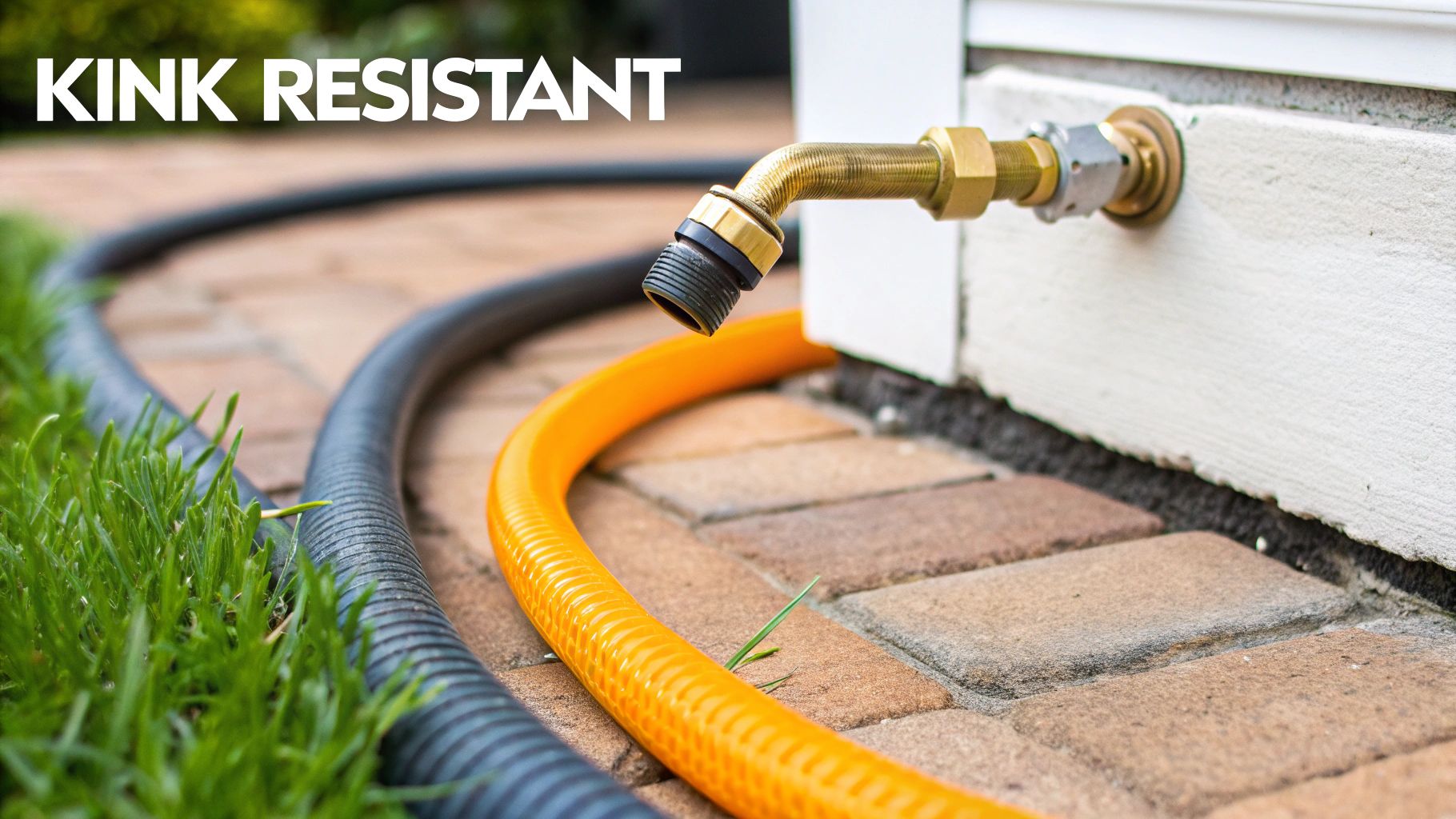
Nothing kills your momentum faster than a sudden drop in water pressure because the hose folded over on itself. Real kink resistance isn't about those flimsy "anti-kink" collars you see at the spigot; it's a core part of the hose's construction. The best ones use multiple layers and a strong reinforcing mesh to hold their shape.
- Material Matters Most: A thick-walled rubber or high-quality hybrid polymer hose is your best bet. They have an inherent stiffness that prevents them from creasing and cutting off water flow.
- Cheap Vinyl is the Enemy: On the other hand, those basic vinyl hoses are almost guaranteed to kink. They're thin and just don't have the structural integrity, especially once they’ve been sitting in the sun or cold.
You'll know the difference the first time you pull the hose around a tire. A good one glides right along, but a cheap one will immediately fold, forcing you to walk back and fix it. Investing in quality material is the only true fix for this headache.
Flexibility and Weight: The Ergonomic Duo
Flexibility and weight are two sides of the same coin, and they directly affect how tired you get during a wash. A hose that’s too stiff or heavy is a pain to drag around. Even worse, it’s more likely to rub against your car’s paint, leaving behind swirl marks.
A great car wash hose uncoils easily and lays relatively flat. This is where premium rubber and hybrid polymers really shine. They stay pliable even when it gets chilly, a condition that turns a cheap vinyl hose into a rigid, unmanageable tube.
The User Experience Test: A flexible, lightweight hose makes all the difference. You should be able to operate your spray nozzle or foam cannon with one hand, easily navigating around mirrors and wheels while keeping the hose off the paint. It just reduces the physical strain.
Built to Last: Durability and Weather Resistance
Let's face it, your driveway is a rough place. Hoses get dragged across abrasive concrete, baked by UV rays, and exposed to wild temperature swings. Durability is what ensures your investment lasts for more than a single season.
The outer jacket is the hose’s first line of defense. A quality rubber or polymer hose has an abrasion-resistant cover that won't easily scuff or get punctured. This is huge—even a tiny pinhole leak can ruin a hose or seriously drop your water pressure.
Temperature and Environmental Impact
The sun is one of the biggest threats to any hose. UV exposure makes materials brittle, leading to cracks and failure. Hoses with a UV-resistant rating will keep their color and flexibility for far longer.
Climate also plays a major role in how a hose performs.
- Cold Weather: In colder areas, a standard vinyl hose becomes incredibly stiff and can even crack in freezing temps. Rubber and hybrid hoses, however, are known for staying flexible well below freezing.
- Hot Weather: In serious heat, some low-grade hoses can get too soft and become more likely to burst, especially if left pressurized in the sun. Look for a hose with a high burst pressure rating (over 350 PSI) for peace of mind in hot climates.
Ultimately, picking the right hose means matching these performance features to your needs. Once you've got that figured out, you can take things to the next level and learn how to turn your hose into a pressure washer for some serious cleaning power.
Matching Your Hose to Your Foam Cannon
A great foam cannon is an amazing tool, but it's only half of the equation. Think of it like a high-performance engine—it can't hit its redline without the right fuel supply. For a foam cannon, that fuel is a steady stream of high-flow, high-pressure water, and your hose is the pipeline that delivers it.
The characteristics of your hose—its diameter, length, and even the fittings you use—are directly responsible for the quality of foam you'll produce. Using the wrong hose essentially starves the cannon, leaving you with runny, weak suds that just slide off your car instead of clinging to lift away dirt. Getting this part right is the absolute key to unlocking that thick, shaving-cream-like foam we're all chasing.
The Critical Role of Hose Diameter
If there's one spec to obsess over, it's your hose's internal diameter. This single factor dictates the volume of water, measured in Gallons Per Minute (GPM), that can reach your foam cannon. The more water volume you have, the more effectively the cannon can mix it with air and soap to generate that dense, rich foam.
This is exactly where the standard 1/2-inch garden hose falls flat. Its narrow internal passage is a major bottleneck that restricts water flow, almost always leading to disappointing results. Even with the best foam cannon on the market, a 1/2-inch hose will probably give you a watery, ineffective foam that doesn’t have much cleaning power.
Switching to a 5/8-inch diameter hose is the single most impactful upgrade you can make. It might not sound like a huge difference, but that small increase in size opens the floodgates for a massive boost in water volume. This is the flow your foam cannon needs to work as designed, turning weak suds into thick, clingy foam.
Why Flow Matters: At typical household pressure, a 5/8-inch hose can deliver up to 50% more water than a 1/2-inch hose of the same length. That extra volume is precisely what a foam cannon needs to properly agitate the soap and create a thick, stable lather.
How Hose Length Steals Your Pressure
While diameter is all about volume, the length of your hose directly affects water pressure. As water travels down the hose, it creates friction against the inner walls, which causes it to lose energy. We call this "pressure loss," and the longer the hose, the more pressure you lose by the time the water reaches the end.
A foam cannon needs solid pressure to both create and propel the foam onto your car. If the pressure is too low when it hits the nozzle, the foam will be weak and won't have enough oomph to cover the vehicle properly.
- Under 75 Feet: To get the best performance, try to keep your hose length at 75 feet or less. This gives you plenty of reach for most driveways without a significant drop in water pressure.
- Over 75 Feet: If you’re running a 100-foot hose or longer, you'll likely notice a drop in foam thickness and spray distance. It'll still work, but the performance won't be as impressive as it would be with a shorter hose.
If you absolutely must use a longer hose, make sure you're starting with strong water pressure at the spigot (60 PSI or higher) to help compensate for the inevitable loss. Otherwise, it’s always best to stick to the shortest length that comfortably gets the job done. If you want to dive deeper into getting the most out of your setup, check out our guide on using a foam gun for a garden hose.
Don't Let Your Connections Create a Bottleneck
Finally, let's talk about the small parts that bring everything together. Your hose fittings and quick-connects can easily become chokepoints that restrict water flow, completely undoing the benefits of a good hose.
Many of the cheap, standard quick-connect fittings you find at big box stores have a very narrow internal passage. They act just like a smaller-diameter hose, choking off your water flow right at the end. To keep things moving, invest in high-flow quick-connect fittings. They're specifically designed with a wider opening to preserve water pressure and volume all the way to your foam cannon.
On that same note, make sure your spigot and any nozzles are clean and unobstructed. Leaky, corroded, or poorly designed fittings don't just waste water—they rob you of the performance you paid for. A seamless, high-flow connection from your spigot to your foam cannon is the final piece of the puzzle for achieving that perfect, detailer-grade foam.
Finding the Right Hose for Your Detailing Needs
There’s really no single “best hose for a car wash” that works for everyone. The right choice comes down to how you work, what you’re washing, and the kind of abuse you put your gear through. It’s all about matching the hose’s features to your specific situation.
A weekend enthusiast has completely different needs than a pro who details cars for a living. By figuring out where you fit, you can zero in on the features that actually matter and stop yourself from overpaying for performance you'll never use.
For the Weekend DIY Detailer
If you’re the person who loves spending a Saturday morning making your own car shine, your main goals are balance and convenience. You need a hose that gives you great foam cannon results but is also easy to wrangle, coil up, and toss in the garage when you're done.
Forget those beastly, commercial-grade rubber hoses. While they look tough, you'll quickly get tired of wrestling with one just to wash a single car. You want to focus on a manageable length and weight.
- Primary Goal: A solid mix of performance, easy handling, and simple storage.
- Recommended Length: 50 feet is the sweet spot. It’s long enough for most driveways without creating a tangled mess or causing a noticeable drop in pressure.
- Recommended Diameter: 5/8-inch is a must. Don't go smaller. This size guarantees you’ll get the water flow needed for that thick, satisfying foam from your SwiftJet cannon.
- Best Material: A high-quality hybrid polymer hose is the clear winner here. It gives you the fantastic kink resistance and flexibility of rubber but without all the weight, making it a dream to use.
For the weekend warrior, the best hose is one that makes washing your car fun, not a workout. It should unroll without a fight, help you get great results, and pack away neatly until next time.
For the Professional Mobile Detailer
As a pro, your hose isn't just a tool—it's part of your livelihood. It gets used and abused daily, so your priorities are completely different: you need extreme durability, absolute reliability, and maximum kink resistance. A busted hose costs you time and money, so a cheap one is never a bargain.
You need something that can be dragged across rough concrete and asphalt all day, coiled and uncoiled dozens of times a week, and never, ever kink up in the middle of a job.
Pro-Tip: For a professional, a hose is a core part of your workflow. The minutes you save by not fighting a tangled, kinking hose add up to real hours and more profit over the course of a week.
This is where industrial-grade gear earns its keep. In professional settings, the best hoses are often multi-ply synthetic rubber, sometimes reinforced with textile or wire, and built for constant high-pressure use. Many commercial hoses are rated for working pressures of 1,000–3,000 psi and can handle high temperatures, all in the name of total reliability. If you're curious, you can dig into the automotive hose market to see just how heavy-duty these standards are.
- Primary Goal: Unmatched durability and truly kink-proof performance.
- Recommended Length: 75 to 100 feet. This gives you the flexibility to handle jobs no matter where the client's water spigot is located.
- Recommended Diameter: 5/8-inch is still the go-to. It delivers excellent flow without being ridiculously heavy over a long run.
- Best Material: Premium, heavy-duty rubber is the undisputed king. It has the best abrasion resistance, stays flexible in hot or cold weather, and can take a serious beating day in and day out.
For the RV and Large Vehicle Owner
Washing a massive RV, boat, or semi-truck brings its own unique problem: you need a ton of reach without killing your water pressure. Your standard 50-foot hose just isn't going to get you around a 40-foot motorhome.
The trick is finding a hose that’s long enough to circle the entire vehicle but isn't a nightmare to handle and store. Since you’ll almost certainly be using a pressure washer for a rig this size, feeding it with a quality hose is crucial. You'll want to make sure your whole system is dialed in, so take a look at our tips for setting up your foam cannon for a pressure washer to get the best results.
- Primary Goal: Maximum reach with consistent, strong water pressure.
- Recommended Length: 100 feet is pretty much required. To fight the pressure loss that happens over this distance, look for a dedicated wash hose (often labeled "non-potable"), as they sometimes have a smoother interior lining to reduce friction.
- Recommended Diameter: Stick with 5/8-inch. It's the best choice for maintaining enough flow to properly supply your pressure washer.
- Best Material: A lightweight, durable hybrid polymer hose is the perfect compromise. It delivers the length you need without the back-breaking weight of a 100-foot rubber hose, making it way easier to maneuver around a huge vehicle.
Extending the Life of Your Car Wash Hose
Picking out a great hose is just the start. If you want that investment to pay off for years to come, a little bit of care goes a long way. Proper maintenance is pretty straightforward, but it's the key to making sure your hose is always ready to go and doesn't fail you mid-wash.
Think about the most common hose killer: improper storage. Just leaving a hose lying out in the sun, still full of pressurized water, is a recipe for a short lifespan. Those UV rays beat down on the outer material, making it brittle and prone to cracking. Meanwhile, the constant pressure inside stresses the inner layers, creating weak spots that eventually burst.
Proper Storage and Handling
After every wash, take a minute to drain the hose. Simply lift the end connected to the spigot and walk the length of the hose out. This gets rid of any standing water that can degrade the inner lining and, more importantly, it relieves all that internal pressure.
How you coil it matters, too. We've all seen someone wrap a hose tightly around their arm and elbow—don't do that. It creates sharp bends that lead to permanent kinks and weak points. The best way is to make large, loose loops on the ground. Even better? Get a quality hose reel. It's the ideal storage solution.
Key Insight: The single most effective thing you can do is store your hose in a garage, shed, or under a covered patio, away from direct sunlight. This one simple habit can easily double the life of even a decent hybrid polymer hose.
Installing and Troubleshooting Fittings
Those metal fittings on each end of your hose are crucial, and they need to be handled with a bit of care. When you're attaching a nozzle, spray gun, or quick-connect fitting, always start by threading it on by hand to make sure it's not cross-threaded. Grabbing a wrench and cranking it down right away is a great way to strip the brass threads and cause a leak that you can never fix.

This decision tree helps visualize which hose setup best suits your detailing needs, whether you're a weekend DIYer, a professional, or an RV owner. It really clarifies how priorities shift—from durability for a pro to pure manageability for someone washing their car at home—and why that leads to different recommendations.
If you spot a drip at a connection, your first instinct might be to tighten it more, but hold off. The culprit is almost always the little rubber washer inside the female fitting. Check it first. These washers get worn out, but they're cheap and incredibly easy to replace. Thinking about water systems in general can be helpful; for example, learning how to stop water dripping into a washing machine reinforces just how often a simple seal is the root of a leak.
For a small puncture somewhere along the hose itself, don't just toss it. A dedicated hose repair kit can create a solid, long-lasting fix and save you from buying a whole new hose. Stick with these simple maintenance tips, and your gear will always be in top shape for that perfect wash.
Common Questions About Car Wash Hoses
Even after breaking down all the specs, a few questions always pop up when it's time to actually choose a hose. Let's tackle them head-on so you can make your final pick with total confidence.
Is a Premium Hose Really Worth the Extra Money?
Yes, without a doubt. It's tempting to grab a cheap vinyl hose off the shelf, but the constant kinking, frustratingly low flow, and poor durability will quickly turn your car wash into a chore. You'll spend more time fighting your equipment than actually cleaning.
Investing in a quality hybrid polymer or rubber hose is one of the best upgrades you can make. It’ll last for years, deliver much better performance with your foam cannon, and ultimately save you money and headaches in the long run.
How Do I Pick the Right Hose Length?
Here’s a simple trick: measure the distance from your spigot to the farthest point you'll need to reach on your vehicle. Then, add about 10-15 feet to that number. This extra slack gives you room to move around the car without the hose pulling tight.
For most driveways, a 50-foot or 75-foot hose is the sweet spot. Going too long just adds unnecessary weight and can cause a drop in water pressure, which means weaker foam from your cannon. Only grab a 100-foot hose if you're dealing with a really large property.
A classic mistake is buying a 100-foot hose "just in case." You often end up with lower pressure and a heavy, unwieldy hose that just makes the job harder.
Can I Use an Expandable Hose for Car Washing?
I strongly advise against it. While they're lightweight and easy to store, their magic comes from a very narrow inner tube that severely restricts water flow. That’s a deal-breaker for getting thick foam.
They’re also not built to last. Expandable hoses are notorious for bursting, especially when you have a spray nozzle or foam cannon on the end that builds up back-pressure. For reliable, powerful performance, stick with a standard 5/8-inch non-expandable hose.
Ready to pair a great hose with a foam cannon that delivers? The SwiftJet Car Wash Foam Gun is engineered to work seamlessly with high-flow 5/8-inch hoses, turning a simple wash into a pro-level detailing session. Shop the SwiftJet now and see the difference for yourself.
